

Heavy metals occur naturally in soils
Lead, mercury, and arsenic are among the elements commonly referred to as heavy metals. Numerous articles and studies have examined their presence in teas, particularly in Matcha tea, raising legitimate questions among consumers.
Metals are naturally present in soils due to the erosion of rocks over millions of years. Human activity, such as waste disposal, mining, industrial activities, or the use of chemical fertilizers and certain pesticides in conventional agriculture, can also increase the concentration of heavy metals in certain soils.
Plants can naturally absorb some of these heavy metals present in the soil through their roots, in varying amounts depending on the species and growing conditions. Their presence in plants is therefore linked to their natural growth environment.
Furthermore, this phenomenon does not only affect tea: trace amounts of heavy metals can be present in other crops such as rice, potatoes, coffee, or cocoa. As the absorption of heavy metals by plants is a natural phenomenon, it is virtually impossible to find tea with no traces of these elements whatsoever. What matters, therefore, is measuring the actual amounts present in Matcha and other teas, and interpreting the results to understand whether the tea you consume poses a risk to your health.
What are the potential health impacts of consuming too many heavy metals?
Heavy metals and certain other metallic elements can pose health risks in cases of significant or prolonged exposure. Their effects vary depending on the specific metal, its chemical form, the dose, and the duration of exposure. Some metals can also accumulate in the body over time; this is known as bioaccumulation.
The elements analyzed in our teas—lead, cadmium, mercury, and arsenic—are considered toxic and play no known beneficial biological role in the human body. Other elements, such as iron or copper, are essential for the body to function properly, but can also become harmful when present in excessive amounts.
Each metal has its own specific effects. In particular, lead can affect the development of the nervous system in children. Mercury can affect the nervous, digestive, and immune systems, as well as the kidneys and skin. Prolonged exposure to inorganic arsenic (the most toxic form of arsenic) can cause skin lesions and have neurological and cardiovascular effects, while increasing the risk of certain diseases, including certain types of cancer.
Certain populations are particularly sensitive to the effects of these substances, including young children and pregnant women. In children, whose nervous systems are still developing, exposure to certain toxic metals can have more significant consequences. During pregnancy, certain contaminants can also affect fetal development.
The unique nature of Matcha
Matcha is a unique tea because the entire leaf is ground into powder and consumed, unlike other teas that are infused in hot water. Drinking the whole tea leaf offers many health benefits because 100% of the nutrients contained in the leaf are ingested, but it also warrants special attention regarding heavy metals so that you can consume it with complete peace of mind.
The presence of heavy metals in Matcha does not necessarily represent a health risk, as the amounts detected are generally minimal. The main priority is therefore to have reliable, transparent analyses regarding the quantities of heavy metals contained in your tea, and to interpret the results objectively.
This is why the origin of the tea, traceability, and scientific analyses carried out on the Matcha you consume are essential criteria for determining its quality. At IRO, we favor teas from certified organic plantations, grown in natural environments without the use of pesticides, herbicides, insecticides, or chemical fertilizers.
In the spirit of transparency, we had all our teas tested by an independent certified European laboratory to measure their content of four heavy metals: lead, cadmium, arsenic, and mercury.
You will find detailed analysis reports for each of our teas at the bottom of this article.
Here are the main results and their interpretation.
Lead
There is currently no specific European regulatory limit for lead in tea.
IRO teas range between <0.050 mg/kg and 0.100 mg/kg of lead.
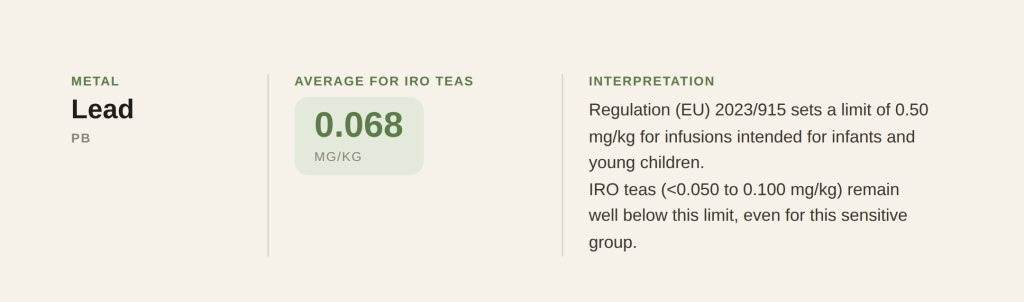
However, Regulation (EU) 2023/915 sets maximum lead levels for various categories of foodstuffs. Among them, a limit of 0.50 mg/kg applies to drinks intended for infants and young children, when marketed as products to be prepared by infusion or decoction (Regulation (EU) 2023/915 Annex I, Section 3.1 “Lead”, point 3.1.25.2).
In conclusion, even for infants and young children, all IRO teas remain well below the regulatory limits for lead.
Cadmium
For cadmium, the concentrations measured in IRO teas are also very low, ranging between 0.012 mg/kg and 0.030 mg/kg:
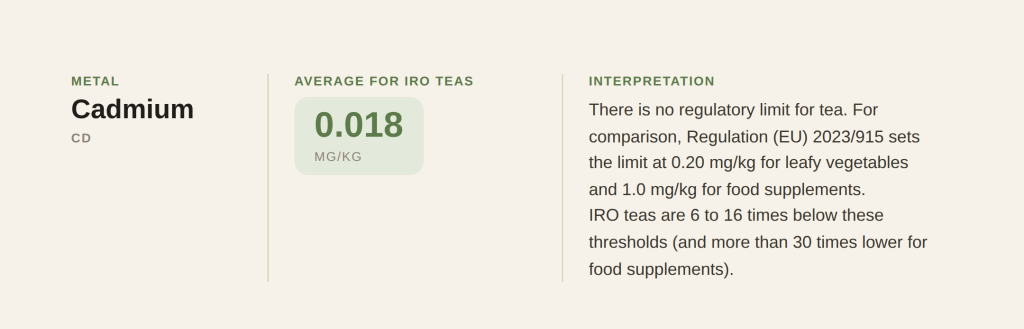
Since there is no regulatory limit for cadmium in tea at the European level, it is relevant to compare our figures with those of other everyday foodstuffs to provide a sense of scale.
The European Union sets a legal limit of 0.20 mg/kg for leafy vegetables (Section 3.2.6 of Annex I to Commission Regulation (EU) 2023/915). By comparison: with measured values between 0.012 and 0.030 mg/kg, IRO teas contain 6 to 16 times less cadmium than the legal limits applied to these commonly consumed vegetables.
To draw another comparison, European regulations also set a general maximum limit of 1.0 mg/kg of cadmium for food supplements (point 3.2.21 of Annex I to Commission Regulation (EU) 2023/915). The concentrations measured in IRO teas are thus more than 30 times lower than this value.
Mercury and Arsenic
Mercury and arsenic are powerful, highly toxic poisons classified by the WHO (World Health Organization) as among the chemical substances of major public health concern.
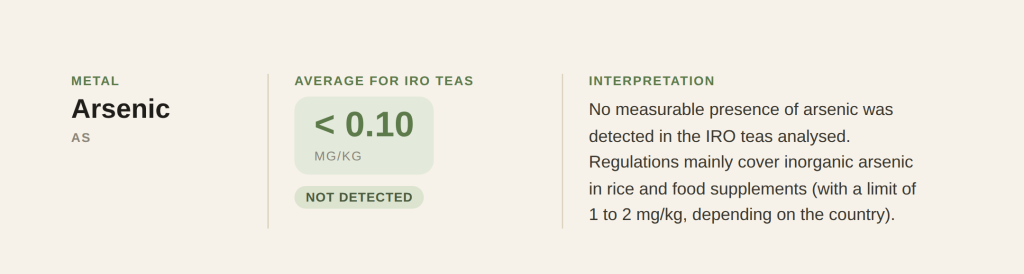
These two heavy metals were undetectable in all analyzed IRO teas. In laboratory analysis results, the presence of the value “less than x mg/kg” (“<0.005 mg/kg” for mercury and “<0.10 mg/kg” for arsenic) indicates that the values are below the limit of quantification of the testing equipment. This means that no measurable trace of these two heavy metals was detected in any of our teas.
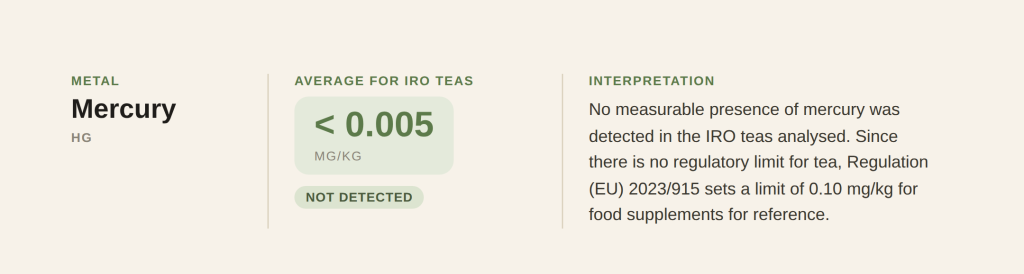
For information, regarding mercury, European regulations mainly set maximum levels for fishery products. However, they establish a maximum level of 0.10 mg/kg for food supplements (Annex I, Section 3.3 “Mercury”, point 3.3.2 of Regulation (EU) 2023/915).
For arsenic, European regulations mainly govern inorganic arsenic (the most toxic form of arsenic) in specific categories of foods particularly concerned, including rice and rice-based products, certain foods intended for infants and young children, as well as fruit juices.
For informational purposes, in Belgium, a Royal Decree sets a value of 1 mg/kg of total arsenic for food supplements (Royal Decree of June 14, 2002).
Conclusion
The analysis results are very reassuring: the heavy metal levels measured in IRO teas are extremely low, and even below the laboratory’s limits of quantification for some of them. The measured levels are very low compared to available reference values and pose no cause for concern within the context of normal tea consumption.
At IRO, we have chosen transparency: rather than simply asserting that our teas are safe, we had each one analyzed by an independent certified European laboratory. The detailed results of these analyses are presented in this article so that everyone can consult the data and form their own opinion.
Beyond testing, the quality of a Matcha is defined by the entire journey of the tea leaf: its origin, its growing environment, the craftsmanship of the producers, and transparency at every step. It is this high standard that guides our selection at IRO, in order to offer you high-quality organic teas, selected with the utmost care.
ANNEXES
Full heavy metal analysis reports for IRO teas:
- Heavy metals analysis report for organic IRO Premium Ceremonial Grade Matcha tea
- Heavy metals analysis report for organic IRO for Cooking Premium Culinary Grade Matcha tea
- Heavy metals analysis report for organic IRO Premium Matcha Genmaicha tea
- Heavy metals analysis report for organic IRO Premium powdered Hojicha tea
- Heavy metals analysis report for organic IRO Premium Sencha tea
- Heavy metals analysis report for organic IRO Premium Genmaicha tea
- Heavy metals analysis report for organic IRO Premium Kukicha tea
🍃 FIND US ON INSTAGRAM! 💚
Recipes, favourite places, discoveries, tea news and giveaways at @matcha.iro
