

In early June 2026, I had the privilege of attending the Tencha auctions—the raw material used to make Matcha—in the Uji region, located in Kyoto Prefecture.
It was a true privilege to be present, as this is a very closed and unique world, generally reserved for professional Japanese buyers.
The auctions I attended focus exclusively on Uji teas. Other major producing regions, such as Kagoshima or Shizuoka, organize their own separate auctions.
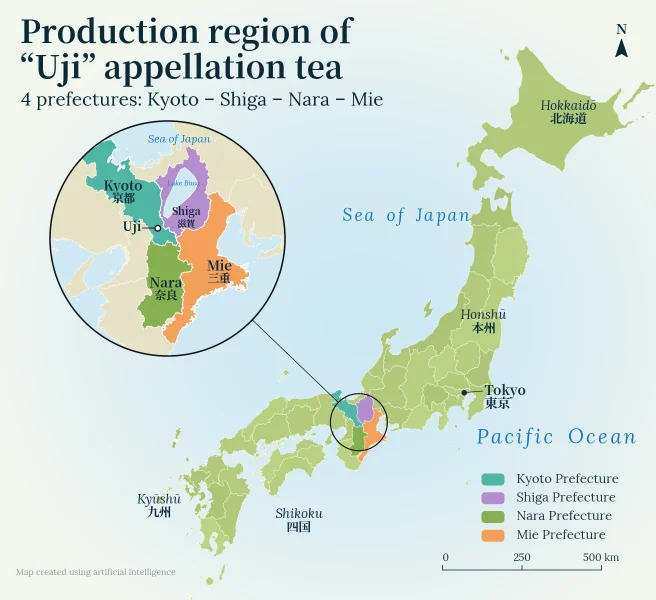
Many people assume that Uji Matcha comes exclusively from the city of Uji itself. However, that is not the reality at all. The city of Uji actually produces a very limited quantity of tea on a national scale: it has relatively few tea fields and is now highly urbanized.
In reality, tea commercialized under the “Uji” designation can originate from four prefectures: Kyoto, Shiga, Nara, and Mie. The designated territory is therefore far broader than just the city of Uji, covering an area approximately 267 times larger.
Why Does the Auction System Exist?
The vast majority of Japanese tea is sold through private contracts between producers/farmers and professional buyers. These buyers may include merchants, wholesalers, tea houses, Matcha manufacturers, or exporters.
A portion of the tea that is not sold under these contracts is then offered at auction.
These can be particularly prestigious teas for which producers hope to fetch a higher price, or lots that are simply not part of a private contract.
Professional buyers often turn to auctions to supplement the quantities they secure through their contracts. This may be necessary when demand or customer numbers rise, or to build up the required inventory for the upcoming year.
However, in the case of the Uji Tencha auctions I attended, the system operates in a much more specific manner than a simple sale to the highest bidder.
How Are the Auctions Organized?
First of all, it is important to know that these auctions do not take place on a single day. For first-harvest teas, they typically span from April to July.
Buyers must therefore adopt a real strategy: is it better to buy right at the start of the season, or wait a month or two in the hope of securing better prices? Are there specific lots they want to acquire (for instance, from a particular farmer or a specific cultivar grown in a dedicated production zone)?
The buyers’ experience and their ability to remain calm under pressure are essential to buying effectively and securing the desired quantities and lots.
Inside the auction room on any given day, numerous lots of Tencha are displayed. On the day we attended, around 300 different lots were up for auction!

Each lot is accompanied by detailed information, such as the location where the tea was cultivated, the cultivar, the farmer’s name, the harvest date, the available quantity, and more.

Auctions are generally split into two sessions throughout the day: one in the morning and one in the afternoon.
How Do Buyers Evaluate the Teas?
Within a strict time limit, buyers must examine the various lots presented, taste the teas that catch their interest, and then place bids on the ones they wish to acquire. This is a real challenge given the limited time, the high number of tea lots displayed, and the fact that the tea is evaluated in its Tencha form rather than its final Matcha state (ground into powder).
The first step is to filter through the numerous lots on display to select those worth closer inspection. The selected Tencha leaves are then evaluated visually: color, appearance, fineness, uniformity, and the potential presence of stems or flaws. Buyers also assess their aroma and aromatic character.
Next comes the tasting phase. To professionally evaluate Tencha, it is steeped in boiling water for at least 2 minutes. This brings out the tea’s fullest characteristics as well as any underlying defects. Indeed, boiling water allows for a broader extraction of the compounds in the leaves, making potential flaws easier to detect. A second visual inspection of the liquor’s color, aroma, and flavor is then conducted by comparing the different selected lots.

Beyond the difficulty of tasting so many different teas in succession, buyers must also be capable of mentally imagining what the Tencha will become once processed into Matcha. Based on the color, aroma, and taste of the Tencha being evaluated, the buyer must anticipate the profile of the Matcha after it is ground into powder.

And I can assure you that it takes tremendous experience to bridge that gap, as the aroma and flavor of raw Tencha are vastly different from the final Matcha product!

We were fortunate to taste several Tencha lots alongside a Japanese tea master holding the 10th Dan in tea evaluation—the absolute highest rank in the grading system of Japan’s national technical tea evaluation competition.
To give you an idea of how rare this achievement is: the national competition has existed since 1956, and following the 2025 edition, only 30 people in all of Japan have ever obtained this title.
What impressed me most was undoubtedly the speed with which he was able to evaluate a tea and decide whether or not it was worth bidding on.
How Do the Auctions Work?
Today, the Uji Tencha auctions are conducted using electronic terminals. For each lot, buyers enter the maximum price they are willing to offer directly into their terminal.
The bidding is done by secret ballot, meaning buyers cannot see the bids placed by other participants. This system can drive prices up significantly during periods of high demand for Matcha. This is especially true today, as Matcha experiences surging global demand and buyers must secure sufficient quantities of Tencha to satisfy their clientele.
Once the bidding window closes, all participants gather in an auditorium for the announcement of the results. The principle is simple: for each lot, the buyer who submitted the highest bid wins the tea. The final price of each lot is publicly displayed so that everyone knows the selling price of the various Tencha lots.
It is interesting to note that the auction system is not identical across all prefectures in Japan.
For instance, in prefectures producing smaller volumes—such as Saga, located in northwestern Kyūshū—the process can differ. Saga’s production is also characterized by different tea types than those predominantly found in Kyoto, notably Tamaryokucha, Kamairicha, and Sencha.
In Saga, auctions resemble a live open outcry sale. Teas are presented on large black plates in the form of aracha—unrefined crude tea that has only undergone the initial processing steps after harvesting (by comparison, Tencha can be viewed as the “aracha” destined to become Matcha).
Buyers inspect the lots of interest and write down their proposed prices along with their tasting notes on summary sheets listing all available lots.
Once the evaluation period ends, buyers assemble in a room, seated around numbered tables. The bidding then begins, lot by lot. The minimum price set by the producer appears on a screen, and buyers place their bids using a buzzer connected to their table.
Prices rise rapidly live on the screen with every buzz, and the highest bidder wins the lot.
The entire process takes place at a blistering pace, as bids must be placed on around a hundred different lots over the course of the day.
What Proportion of Japanese Tea Is Sold at Auction?
Contrary to popular belief, the majority of Japanese Tencha is not sold at auction.
A significant share of production is sold through direct contracts between farmers or cooperatives and tea houses, Matcha manufacturers, or other professional buyers.
However, auctions play a vital role in price discovery. The prices at which lots are sold serve as a benchmark for market players and often form the basis for negotiations and pricing for crops sold under private contracts.
The influence of auctions extends far beyond the specific lots sold on the floor. This became particularly evident in 2025, when the Japanese Matcha market experienced severe supply tightness due to a massive surge in global demand combined with lower-than-usual harvest yields caused by weather conditions.
In 2026, these market pressures persisted: global demand continued its rapid growth while supply failed to keep pace, despite many fields previously dedicated to other tea types being converted to Tencha production for Matcha.
I hope this article gave you a fascinating glimpse into a lesser-known side of the Japanese tea world and helped you better understand what goes on behind the scenes at Tencha auctions.
François
Founder of IRO
🍃 FIND US ON INSTAGRAM! 💚
Recipes, favourite places, discoveries, tea news and giveaways at @matcha.iro
